Arvicola amphibius
(Linnaeus, 1758)
Eurasian Water Vole
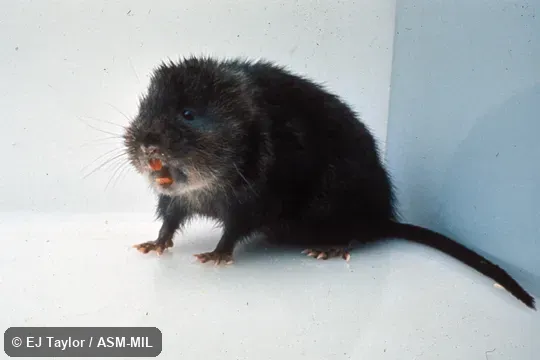
Distribution :
Europe (excluding C and S Spain but including N Spain and N Portugal) east through Siberia to Lena River Basin (Yakutskaya); from Arctic Sea south to Lake Baikal and N Tien Shan Mtns of NW China (Xinjiang) through NW Iran, Iraq, N Israel, Caucasus, and Turkey; also in Great Britain except Ireland
Image courtesy of the ASM Mammal Images Library · MIL ID: 748
Taxonomy
| Subclass | : Theria |
| Infraclass | : Placentalia |
| Magnorder | : Boreoeutheria |
| Superorder | : Euarchontoglires |
| Order | : Rodentia |
| Suborder | : Supramyomorpha |
| Infraorder | : Myomorphi |
| Superfamily | : Muroidea |
| Family | : Cricetidae |
| Subfamily | : Arvicolinae |
| Tribe | : Arvicolini |
| Genus | : Arvicola |
Species status
Authority citation
Linnaeus, C. 1758-01-01. Systema naturæ per regna tria naturæ, secundum classes, ordines, genera, species, cum characteribus, differentiis, synonymis, locis. Tomus I. Editio decima, reformata. Laurentii Salvii, Stockholm, 823 pp.
Authority publication link
Original name as described
Mus amphibius
Other common names
European Water Vole · Water Vole
Type locality
England.
Biogeographic realm
Palearctic
Country distribution
Albania · Austria · Azerbaijan · Belarus · Belgium · Bosnia and Herzegovina · Bulgaria · China · Croatia · Czech Republic · Denmark · Estonia · Finland · France · Georgia · Germany · Greece · Hungary · Iran · Italy · Kazakhstan · Kosovo · Latvia · Liechtenstein · Lithuania · Luxembourg · Moldova · Mongolia · Montenegro · Netherlands · North Macedonia · Norway · Poland · Portugal · Romania · Russia · Serbia · Slovakia · Slovenia · Spain · Sweden · Switzerland · Turkey · Ukraine · United Kingdom
Taxonomy notes
previously included A. italicus and A. persicus; monticola (also known as sherman and terrestris) is often considered a distinct species but recent molecular and morphological data support it as a subspecies/synonym of A. amphibius; populations identified as A. amphibius from Azerbaijan were shown to be sister to A. persicus, but these populations may represent a distinct species
Taxonomy notes citation
Gippoliti, S. 2012. The name of the Italian water vole Arvicola cf. amphibius (Linnaeus, 1758). Hystrix, the Italian Journal of Mammalogy 23(2):87-89. a#58853 · Kryštufek, B., Koren, T., Engelberger, S., Horváth, G.F., Purger, J.J., Arslan, A., Chişamera, G. and Murariu, D. 2015. Fossorial morphotype does not make a species in water voles. Mammalia 79(3):293-303. doi:10.1515/mammalia-2014-0059 · Mahmoudi, A., Maul, L.C., Khoshyar, M., Darvish, J., Aliabadian, M. and Kryštufek, B. 2020. Evolutionary history of water voles revisited: confronting a new phylogenetic model from molecular data with the fossil record. Mammalia 84(2):171-184. doi:10.1515/mammalia-2018-0178 · Chevret, P., Renaud, S., Helvaci, Z., Ulrich, R.G., Quéré, J.-P. and Michaux, J.R. 2020. Genetic structure, ecological versatility, and skull shape differentiation in Arvicola water voles (Rodentia, Cricetidae). Journal of Zoological Systematics and Evolutionary Research 58(4):1323-1334. doi:10.1111/jzs.12384 · Bulycheva, S. V., Markova, E. A., Yalkovskaya, L. E., Nadirli, L. V., & Borodin, A. V. Phylogenetic relationships of water voles (Arvicola, Rodentia) of Azerbaijan according to the cytochrome b gene.
IUCN Red List status
Least Concern
Species Permalink
Country distribution map
The map below provides a general overview. Most species inhabit only specific regions within countries. Hover over the highlighted regions to see the country name.
Names and synonyms
Present and past (if available) associated names to the species. Click on a name to view its details.
Total: 144 names and synonyms.
134 more names and synonyms available — use the desktop version to see them all.
Show 134 more names and synonyms
Please send any edits, corrections, or unfilled data (including full citations) to mammaldiversity [at] gmail [dot] com.